
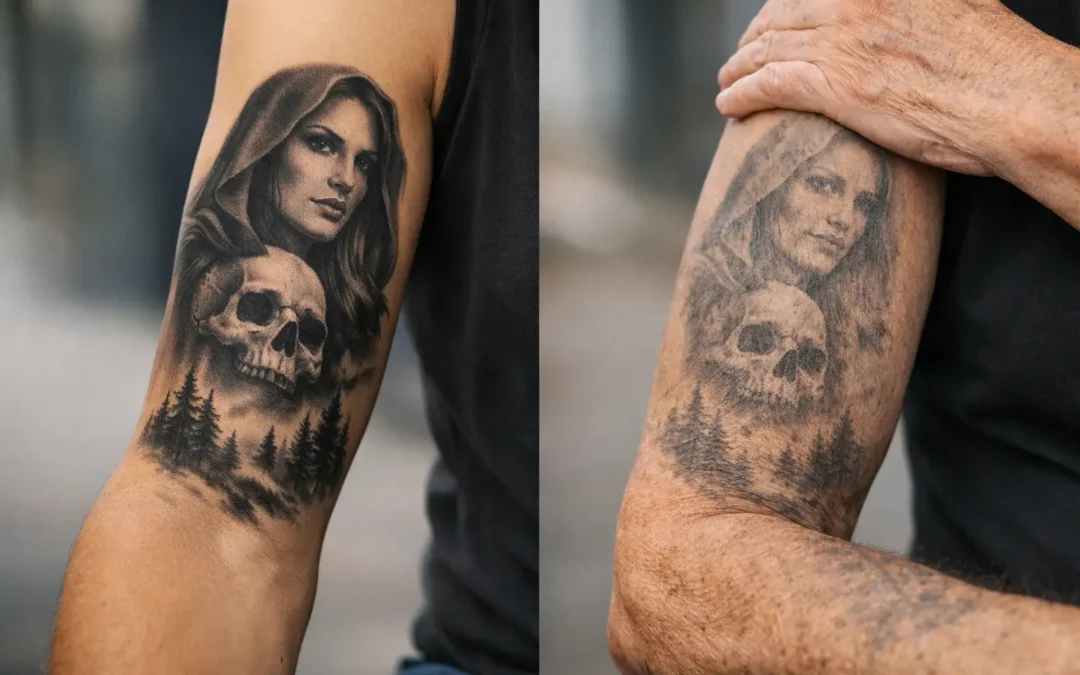
A black and grey tattoo does not simply fade into nothing. It changes with your skin, your lifestyle, the quality of the original work, and the choices made before the needle ever touches the skin. So, how do black and grey tattoos age? Well-designed work can remain striking for decades, but the fine details, contrast, and edges need to be planned with the future in mind.
That is why black and grey tattooing is more than putting a grayscale image on skin. It is an art of depth, spacing, texture, and restraint. Whether you are considering a portrait, a realistic piece, a fine-line design, or the beginning of a larger sleeve, an experienced artist should design for the tattoo you will wear years from now, not only for the fresh photo taken on appointment day.
How Do Black and Grey Tattoos Age on Skin?
Over time, every tattoo softens to some degree. Tattoo pigment sits in the dermis, beneath the outer layer of skin. Your body does not treat it exactly like a permanent printed image. As skin renews itself, responds to sun exposure, stretches, and naturally changes with age, the ink can appear less crisp than it did when it was fresh.
Black ink usually has strong staying power. A solid black area often remains readable longer than very pale gray washes or extremely fine details. Grey tones can soften more noticeably because they are created by diluting black pigment or using lighter applications. This is not a flaw. In a well-executed black and grey tattoo, that softer transition is part of the visual character.
The goal is not to promise that a tattoo will look frozen in time. The goal is to create artwork that still reads clearly, feels balanced, and keeps its identity as it matures.
Contrast matters more than tiny detail
The tattoos that age best usually have a thoughtful range from dark to light. Strong blacks create anchors for the eye. Midtones build dimension. Open skin and lighter areas give the design room to breathe. When those elements are balanced, the tattoo can remain readable even as its softer values mellow.
A design packed with tiny lines, pale shading, and no breathing room may look delicate when fresh but can lose separation over the years. This is especially true when fine details are placed close together. As the tattoo naturally softens, those details can begin to merge visually.
That does not mean you have to avoid detail. It means detail should be placed with purpose. A skilled artist knows where a portrait needs crispness, where texture can be simplified, and where a little more negative space protects the composition long-term.
What Fades First in Black and Grey Tattoos?
Light gray wash, white highlights, and ultra-fine linework are usually the first areas to become less distinct. White ink often heals subtly from the beginning and may take on the surrounding skin tone over time. Pale gray shading can remain beautiful, but it may lose some of the contrast that made it appear airy and soft when new.
Fine-line tattoos have their own trade-off. They can look elegant, clean, and understated, especially for smaller custom pieces. But a line that is extremely thin has less visual weight to begin with. If the design relies entirely on hairline marks, it may look lighter or less defined as the years pass.
Solid black sections, bolder outlines, and clear shadow structure tend to hold their presence better. For realistic black and grey work, the best long-term results often come from using selective deep blacks rather than making every area equally dark. Too much black can flatten a piece; too little can leave it without a lasting foundation.
Placement Changes the Aging Story
Where you place a tattoo has a real effect on how it wears. Areas with frequent sun exposure, friction, movement, or regular shedding can require more maintenance. Hands, fingers, feet, palms, elbows, knees, and the inner lip are known for being less predictable than areas such as the upper arm, outer forearm, thigh, calf, back, or chest.
Hands and fingers, for example, are exposed to washing, sunlight, and constant use. A detailed black and grey design there can be meaningful and visually powerful, but it may need a touch-up sooner than a similar design on the upper arm. That is not a reason to avoid the placement. It is a reason to make an informed choice and design appropriately.
Skin changes also vary by body area. Weight fluctuations, muscle growth, pregnancy, and aging can alter the way a tattoo sits. Larger, well-composed designs generally adapt more gracefully than tiny, overly intricate images forced into areas that move or stretch significantly.
Artist Technique Makes a Lasting Difference
The way ink is applied matters as much as the design itself. If pigment is placed too shallowly, parts of the tattoo may heal unevenly or fade early. If it is placed too deeply, the ink can spread beneath the skin, creating a blurred appearance often called a blowout. Neither outcome is ideal for clean black and grey work.
Consistent saturation, smooth shading, and intentional line weight come from technical control. They also come from an artist taking the time to understand the project. A custom sleeve, portrait, or cover-up needs a different strategy than a small fine-line tattoo. Skin tone, existing scars, older ink, placement, and the client’s lifestyle all influence the plan.
At Socrates Ink Gallery, the consultation is where that planning starts. Bringing references is helpful, but the strongest result comes from translating the feeling, story, and visual direction behind those references into a design made for your body. That is how a tattoo becomes personal artwork rather than a copy of an image that may not age well on skin.
Healing Can Protect or Compromise the Result
The first few weeks matter. A fresh tattoo is an open wound, and aftercare is part of the process of preserving the artist’s work. Keep the area clean, follow your artist’s instructions, and use only the recommended amount of aftercare product. Over-moisturizing can be just as unhelpful as letting the tattoo dry out completely.
Do not pick peeling skin or scabs. Avoid swimming, soaking, and intense sun exposure while the tattoo heals. Friction from tight clothing or workouts can also irritate a new piece, especially in high-movement areas.
Once the tattoo is healed, daily life becomes the bigger factor. Sun exposure is one of the most common reasons tattoos appear faded early. UV light can dull black ink and reduce the separation between black, grey, and skin-tone highlights. Tampa clients in particular know how quickly outdoor time adds up. Cover the tattoo when practical, and use broad-spectrum sunscreen on fully healed skin whenever it will be exposed.
Healthy, moisturized skin also helps a tattoo look clearer. Lotion will not restore lost ink, but dry skin can make healed work look temporarily dull and ashy. Basic skin care, hydration, and sun protection support the appearance of any tattoo over time.
When a Touch-Up Makes Sense
A touch-up is not always necessary, and it is not a sign that a tattoo failed. Some placements, styles, and skin types simply heal differently. Small areas of uneven saturation, softened highlights, or faded lines can often be refreshed after the tattoo has fully settled.
For larger black and grey work, waiting gives you and your artist a clearer picture of how the piece has healed. It is better to make a deliberate adjustment than rush back into the skin before it is ready. In some cases, a tattoo does not need more ink at all. A design that has softened naturally may still look balanced and lived-in.
The best time to discuss touch-ups is during your original consultation and aftercare conversation. Clear expectations protect the experience. Your artist should be honest about the placement, detail level, and maintenance your chosen design may require.
A black and grey tattoo should grow into your skin with confidence, not depend on a fresh-photo finish to make an impact. Choose an artist who respects the long view, give the design room to breathe, and protect it after it heals. The result can carry your story with clarity for years to come.