
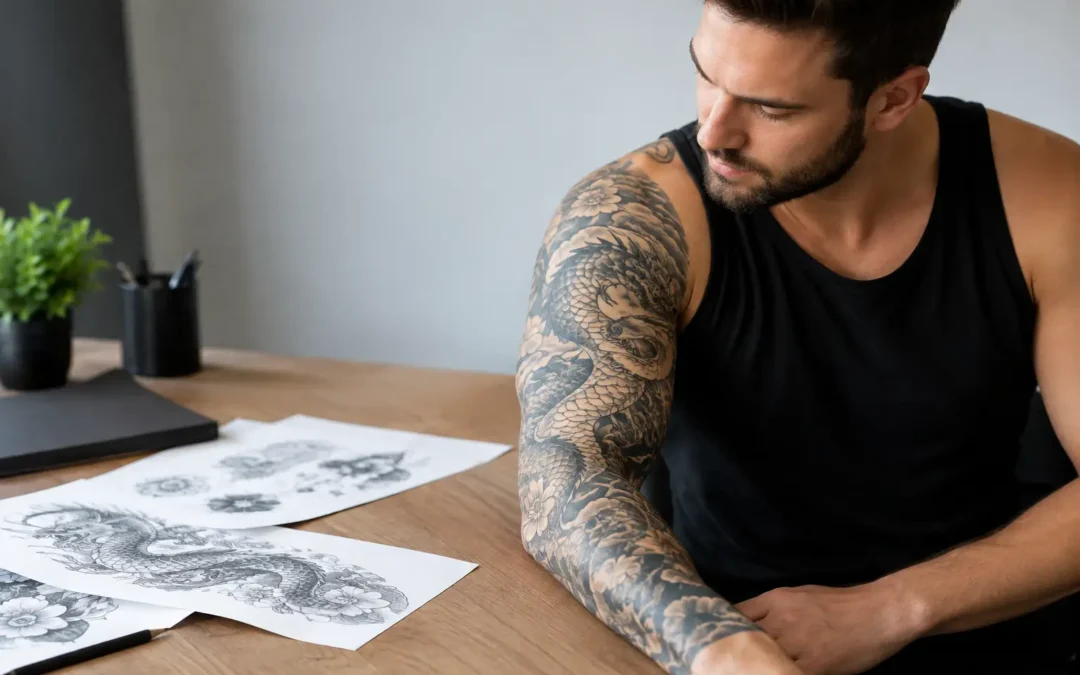
A great sleeve should not feel like several good tattoos that happened to land on the same arm. It should feel intentional from shoulder to wrist, with movement, contrast, and details that still make sense when someone sees the whole piece from across the room. That is why full sleeve planning matters long before the first stencil goes on.
Whether you are starting with a blank arm or building around tattoos you already have, a sleeve is a major art project. It takes vision, patience, and an artist who can translate personal ideas into a composition made for your body. The goal is not to fill every open space as quickly as possible. The goal is to create artwork you will be proud to wear for life.
Start Full Sleeve Planning With the Big Picture
Before choosing individual images, decide what you want the sleeve to communicate. It can honor family, reflect a cultural connection, represent personal growth, or simply create a visual style that feels like you. There is no wrong reason to get tattooed, but a clear direction gives the design real staying power.
Try to think in themes instead of isolated tattoo requests. A client may come in wanting a rose, a clock, a portrait, and a dove. Those elements can work beautifully together, but only if they share a story, a visual language, or a consistent mood. An artist can use light, shadows, background texture, and transitions to make separate ideas feel like one complete piece.
Bring references to your consultation, but do not feel pressured to find a finished sleeve online and copy it. References are most useful when they show what you respond to: the bold movement in Japanese-inspired work, the smooth realism of black and grey, the saturation of color, or the clean restraint of fine-line details. Your sleeve should be built around your arm and your story, not someone else’s tattoo.
Choose a Style That Can Carry the Entire Arm
A sleeve gives an artist room to create depth, rhythm, and large-scale impact. That does not mean every style needs the same approach. Black and grey sleeves can use value, texture, and negative space to create a dramatic flow. Full-color work can use a controlled palette so the sleeve stays strong without becoming visually crowded. Japanese-inspired sleeves often rely on background elements such as wind bars, waves, clouds, flowers, or smoke to connect major subjects naturally.
Portrait sleeves require especially careful planning. A portrait can be the emotional center of the piece, but it needs enough open space and contrast around it to remain readable. Placing a highly detailed portrait beside several equally detailed images can make the entire design compete with itself.
Mixing styles is possible, but it comes with trade-offs. Fine-line imagery beside bold traditional elements, for example, may look disconnected unless the artist has a clear strategy for line weight, shading, and transitions. If you want a mixed-style sleeve, say so early. It is much easier to design that balance from the beginning than to force it together later.
Decide Where the Focal Point Belongs
The shoulder, upper arm, outer forearm, and inner forearm all carry visual weight differently. Most sleeves need one or two focal points – the images your eye lands on first. A lion, goddess, dragon head, portrait, skull, tiger, or large floral element may be perfect for a prominent area, while supporting details move around the arm.
The outside of the forearm is highly visible and often works well for a strong statement image. The inner arm is more personal and can hold meaningful names, script, or a quieter detail. The elbow is not usually the best place for a face or fine lettering because movement and skin texture can affect readability. Instead, artists may use a flower, web, ornamental pattern, or background texture that works with the joint.
A skilled artist plans for the arm in the round. What looks good in a flat drawing may not work once it wraps around a shoulder, bends at the elbow, and narrows at the wrist.
Plan for Flow, Not Empty-Space Panic
One of the biggest sleeve mistakes is treating every bare spot as a problem. Skin breaks, soft shading, and negative space give a tattoo room to breathe. They also help the major images stand apart.
Background is not filler. It is what turns individual concepts into a sleeve. Depending on the style, that might mean smoke, clouds, filigree, waves, foliage, geometric structure, soft shadows, or abstract texture. The best backgrounds support the main subjects without stealing attention from them.
This is also where cover-up work needs an honest conversation. Existing tattoos can sometimes be incorporated into a larger sleeve, and sometimes they need to be disguised with darker shapes, strategic placement, or a change in subject matter. A cover-up may limit how light or delicate parts of the final sleeve can be. Being open with your artist about what is already there leads to a better design and more realistic expectations.
Think in Sessions, Healing, and Budget
A full sleeve is rarely a one-day decision or a one-session tattoo. Large custom work is built over multiple appointments, allowing time for drawing, application, healing, and refinement. The number of sessions depends on the style, coverage, level of detail, skin condition, and how well your body tolerates longer appointments.
Give yourself breathing room between sessions. Freshly tattooed skin needs proper aftercare and time to settle before more work is added nearby. Healing also gives you and your artist a chance to see how the design is reading on your body before moving into the next section.
Budget matters too. Quality tattooing is not the place to chase the lowest price. You are paying for original design work, technical skill, professional equipment, clean procedures, quality materials, and the time required to execute a large piece correctly. If your ideal sleeve is bigger than your current budget, it is usually smarter to build it in stages than to compromise the design or rush the work.
Prepare for a Productive Consultation
A consultation is where your ideas become a workable tattoo plan. Come ready to talk about your theme, preferred style, placement, existing tattoos, timeline, and any images or symbols that matter to you. Be honest about what you do not want as well. Knowing that you dislike heavy black backgrounds, bright color, or overly realistic imagery is just as useful as knowing what you love.
Trust should go both ways. You should feel heard, but you should also be willing to hear professional guidance about size, placement, contrast, and longevity. An artist may recommend making a feature larger so it stays readable, moving an element away from a difficult area, or simplifying details that will not age well. That is not a rejection of your idea. It is part of protecting the final result.
At Socrates Ink Gallery, the consultation-to-drawing process is built around that collaboration. Omar Cruz approaches large-scale work as custom art, not a menu of interchangeable images. The strongest sleeves come from a shared plan, clear communication, and respect for the process.
Leave Room for the Future
You do not need to know every detail of a sleeve before beginning, but you should know the direction. Some clients prefer to complete the entire arm from shoulder to wrist. Others start with an upper-arm section or forearm centerpiece and expand over time. Both approaches can work.
The key is telling your artist that you may continue later. Even if you are only tattooing one section now, the edges, background, and placement can be designed with future additions in mind. This prevents the common problem of trying to connect unrelated tattoos years later.
Your sleeve does not need to explain itself to everyone who sees it. It needs to feel right when you look down at your own arm. Give the idea time, choose an artist whose work matches the direction you want, and trust a process built for the long view. That is how permanent artwork earns its place on your skin.