
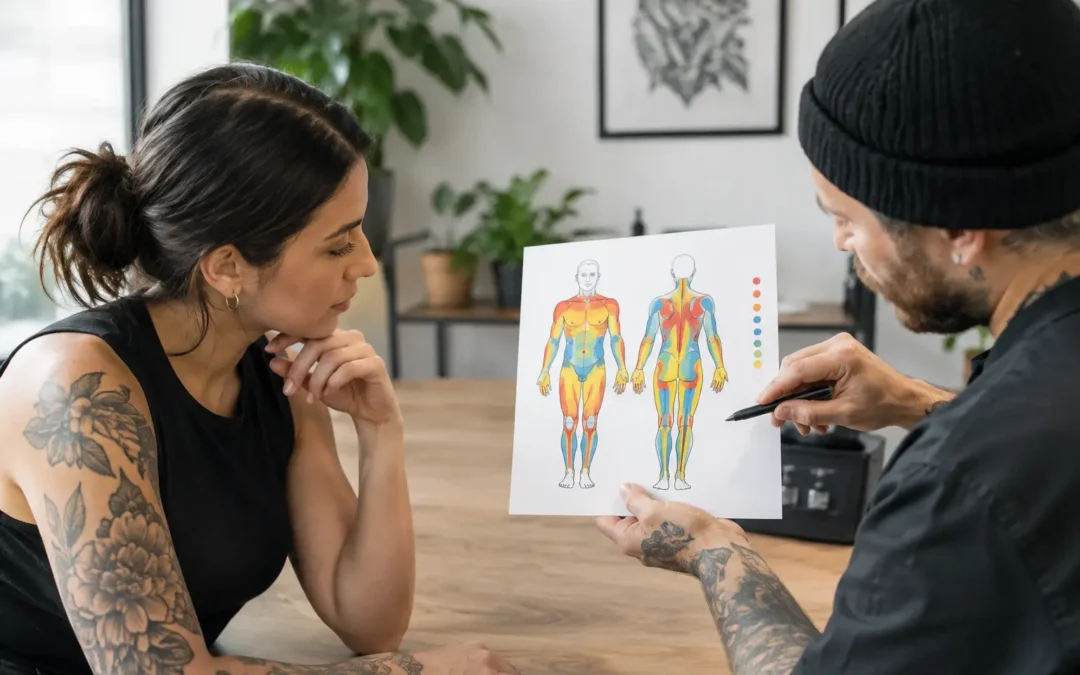
A tattoo pain chart can be useful when you are choosing placement, but it should never be the only thing deciding where your artwork belongs. The right placement has to work with the design, your lifestyle, and the way you want to wear your tattoo for years. Pain matters, especially for a first tattoo, but meaningful art is worth planning with the full picture in mind.
Every person experiences tattooing differently. What feels like a mild scratch to one client may feel intense to another. Your sleep, stress level, hydration, anatomy, session length, and the artist’s approach all shape the experience. Think of pain charts as a conversation starter for your consultation, not a promise of exactly what you will feel.
How to Read a Tattoo Pain Chart
Most tattoo pain charts use a body outline with colors or numbers to show commonly easier and harder areas. Fleshy parts of the body tend to be more comfortable because there is more padding between the needle and bone. Areas with thin skin, exposed bone, dense nerve endings, or frequent movement usually feel sharper.
A simple way to interpret the chart is by broad ranges rather than treating every area as an exact score:
- Lower sensitivity: Outer upper arm, forearm, outer thigh, calf, and upper back are often manageable choices for first tattoos.
- Moderate sensitivity: Shoulder, chest, inner arm, lower leg, and parts of the back can be very workable, though detail and session length make a difference.
- High sensitivity: Ribs, sternum, inner thigh, knee, elbow, neck, and ankle commonly demand more focus and endurance.
- Very high sensitivity: Feet, hands, fingers, armpits, nipples, groin, spine, and certain areas near joints are frequently among the most challenging placements.
That range still has plenty of variation. A muscular forearm may feel easy for one person, while another client finds the closer-to-the-wrist area surprisingly sharp. A rib tattoo may be intense, but a smaller design can be completely manageable. Scale, style, and duration matter as much as the body part itself.
Tattoo Pain Chart by Placement
Arms, shoulders, and hands
The outer upper arm is one of the most popular placements for a reason. It offers a relatively comfortable canvas and enough room for fine-line work, color designs, black and grey pieces, or the first stage of a future sleeve. The shoulder cap and outer forearm are also solid options for clients who want to ease into tattooing.
The inner bicep and inner forearm can feel more sensitive because the skin is softer and the area has more nerve endings. The elbow itself is difficult for many people due to the bone and constant motion. If you are planning a sleeve, these spots are part of the process, but they do not have to be tattooed first.
Hands and fingers tend to be more intense, and they come with another consideration: longevity. Skin on the hands gets sun exposure, friction, washing, and daily wear. Small details may soften or require touch-ups over time. A strong design, realistic expectations, and proper aftercare matter here.
Chest, ribs, back, and stomach
The upper back can be a comfortable area for larger artwork, particularly across the shoulder blades where there is more muscle. As tattooing moves toward the spine, shoulder blade edges, or lower back, the sensation often becomes more pronounced. Back pieces also test endurance because they are usually larger and take multiple sessions.
Chest tattoos vary widely. The outer chest can be manageable, while the sternum and collarbone area are more sensitive because of thinner skin and proximity to bone. Ribs are known for a sharper sensation, partly because breathing moves the canvas throughout the session. An experienced artist will guide you through positioning and help keep the process controlled.
The stomach is not automatically a high-pain area, but the skin can be tender and mobile. Placement is especially worth discussing if weight changes, pregnancy, or future cover-up work are part of your long-term considerations.
Legs, feet, and ankles
Outer thighs are often among the easier places to get tattooed. They offer a large, stable area for portraits, Japanese-inspired work, color, and bold custom compositions. Calves can also be approachable, although the back of the knee and the area near the shin are usually more sensitive.
The shin has very little cushioning, which creates a more direct, vibrating sensation. Knees can be tough because the skin is tight and the joint moves constantly. Ankles and feet are also high on many tattoo pain charts due to bone, thin skin, and sensitivity. They can still make beautiful placements, but they are usually better approached with realistic expectations and a well-planned design.
Neck, head, and face
Neck tattoos can range from manageable to intense depending on the exact location. The back of the neck may be less challenging than the throat, jawline, or sides of the neck. Head and face tattoos are specialized placement decisions. Beyond discomfort, they are highly visible, and the design must suit your personal style, work life, and long-term goals.
For these areas, consultation matters more than any chart. The strongest tattoo is not just technically well executed. It is thoughtfully placed, designed for the body, and something you are ready to stand behind.
What Changes the Pain Level During a Session
Placement gives you a starting point, but it is not the whole story. Fine-line tattooing can feel different from heavy color packing or dense black and grey shading. Outline work is often described as sharp and scratchy, while shading may feel more like a repeated burn or abrasion. Neither is universally easier.
Long sessions also change the experience. A spot that feels comfortable for the first hour may become more tender as the skin gets irritated. Large-scale projects, including sleeves, back pieces, and cover-ups, are usually best approached as a series of planned sessions. That gives both the artist and the client time to protect the quality of the work.
Your physical condition matters. Arriving dehydrated, hungry, exhausted, sick, or hungover can make a session feel harder than it needs to. Anxiety can also amplify discomfort. There is no prize for pretending you are fine when you need a short pause. Clear communication helps your artist pace the session responsibly.
How to Prepare for a More Comfortable Tattoo
Get a full night’s sleep, eat a real meal beforehand, and drink water throughout the day. Wear clothing that gives your artist easy access to the placement while keeping you comfortable. If you are getting tattooed on your leg, for example, avoid showing up in restrictive clothing that makes positioning difficult.
Skip alcohol before your appointment. It can affect bleeding and make it harder to sit comfortably. Avoid arriving after an intense workout, and do not schedule your tattoo when you are already feeling run-down. If you take medication or have a medical condition that could affect the session, discuss it with a qualified medical professional and let your artist know during the consultation.
Bring what helps you settle in: headphones, a playlist, or someone to drive you home if the placement or session length makes that a smart choice. The goal is not to turn tattooing into a painless experience. It is to arrive prepared, stay steady, and give the artwork the attention it deserves.
Let the Design Lead the Placement
A tattoo pain chart is valuable because it helps you prepare honestly. It should not pressure you to choose an easy location for a design that belongs somewhere else. A delicate botanical piece may flow best along the forearm. A portrait may need the space of a thigh or upper arm. A Japanese-inspired composition may be strongest when it follows the natural movement of a sleeve, leg, or back.
At Socrates Ink Gallery, the consultation process is where placement, scale, style, and comfort come together. Omar Cruz works with clients to translate personal ideas into custom artwork that fits the body, not just an empty space on a chart.
Choose a placement you can commit to, prepare your body for the session, and trust a thoughtful process. The temporary discomfort passes. The art you wear should keep feeling right long after the appointment is over.